
How to perform shoulder exam.
Anatomy
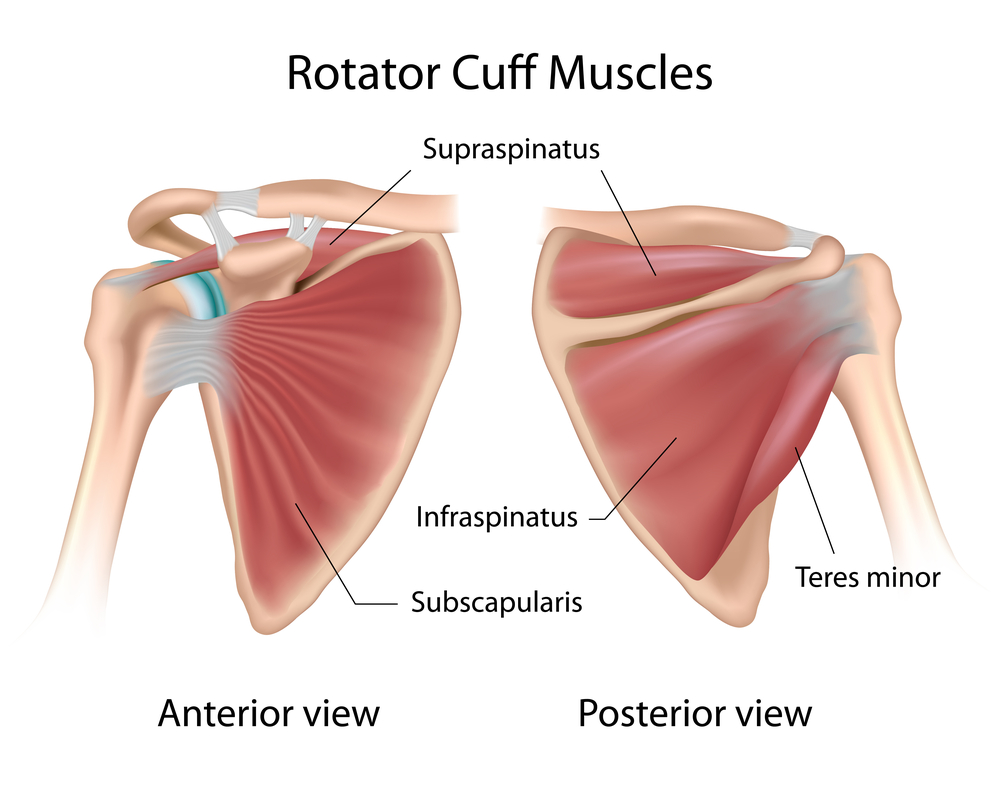
Basics
- Inspection
- Palpation
- Clavicle
- AC joint
- Anterior shoulder and biceps
- Posterior shoulder, trapezius, and neck
- AROM – full AROM > no OA, no tendinitis, no capsulitis
- Special tests
- Muscle Strength
–Supraspinatus – Empty can
–Infraspinatus
–Subscapularis
–Teres Minor - Impingement
–Neer’s/Hawkins tests
- Muscle Strength
Overview of conditions

Supraspinatus Empty can or Jobe test
– Technique: arms held out in front of the patient parallel to the ground with thumbs pointed
downward. Resistance is applied by the examiner and the patient tries to maintain the position
– Pain with resistance may indicate a supraspinatus defect,

Infraspinatus External rotation
– Technique: the arm is held at the patient’s side with the elbow flexed at 90 degrees. The patient is asked to externally rotate the forearm against resistance.
– Pain with resistance may indicate an infraspinatus defect.

Subscapularis Lift-off test
- Technique: patient’s hand is placed behind their back with the dorsum of the hand against the
back. They are asked to lift their hand off their back. - An inability to bring their hand off their back indicates a defect in internal rotation, which may
indicate a subscapularis defect.

Neer test for impingement
- Technique: While stabilizing the scapula, pronate the arm and flex the shoulder to 180º (so that the upper arm is “neer the ear”).
- Pain with this maneuver may indicate rotator cuff impingement.

Hawkin’s test for impingement
The patient’s arm is abducted to 90 degrees with the elbow bent (as if holding the arm
out to catch a hawk), and the examiner internally rotates the shoulder.
Pain with this maneuver may indicate rotator cuff impingement.

Cross-arm test
Technique: patient’s arm is held in front of them to 90 degrees and the patient actively adducts
the arm (crosses it in front of them).
Pain at the acromioclavicular (AC) joint indicates AC joint dysfunction (which can be
confused with rotator cuff pathology).

 Zulfiqar Rana, MD, MPH, FACP