
How to approach a patient with hip pain.
Differential Diagnoses of Regional Hip Pain
Anterior
- Hip Joint Disease, including:
- Osteoarthritis
- Neck Fracture
- Septic Arthritis
- Femoral-Acetabular Syndrome
- Avascular Necrosis
- Meralgia Paresthetica (can be anterior and/or lateral)
Lateral
- Greater Trochanteric Bursitis
- External Snapping Hip
Posterior
- Radiculopathy (see Low Back Exam)
- Sacroiliitis or Sacraliliac Joint Pain
- Piriformis Syndrome
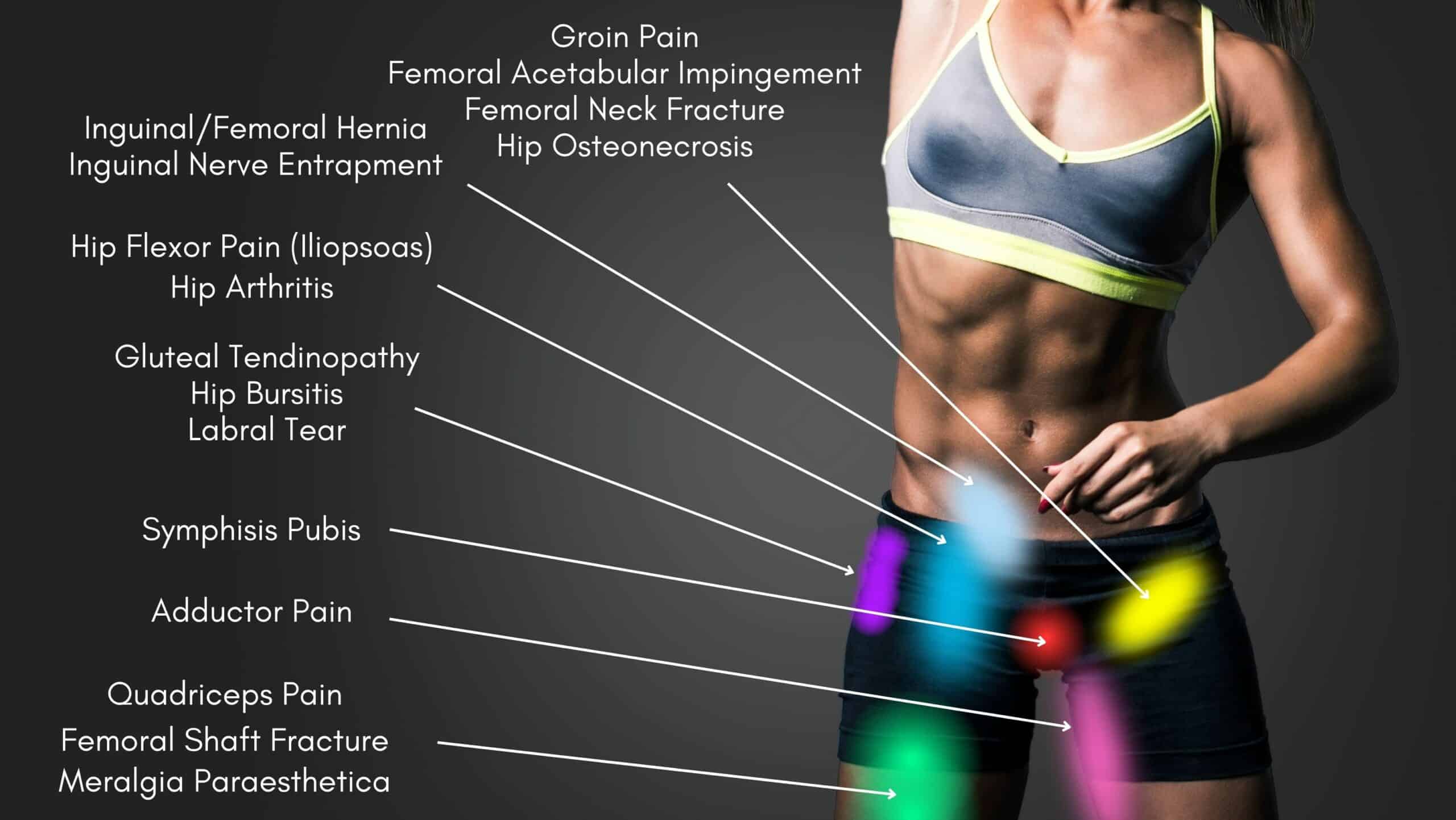
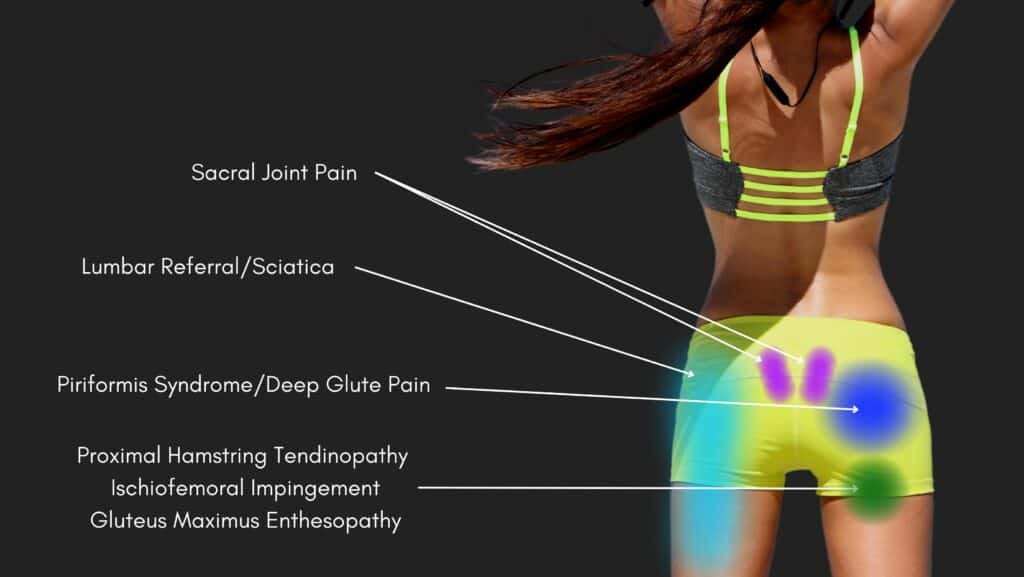
Anterior Hip
Inspection
Palpation esp of the tender areas
Range of Motion of Hip Joint
Tests for range of motion look for pain in the hip joint as the ball-and-socket joint of the hip is activated. The most common cause of pain with range of motion is osteoarthritis (or degenerative joint disease) of the hip but again any of the problems of the hip listed above will likely cause pain during range of motion and/or limitation in range of movement.
Some of these motions include:
- Flexing both hip and knee at 90 degrees, then rotating back-and-forth both internally and externally to approx 45 degrees.
- Flexing the hip and knee beyond 90 degrees to the extremes of range of motion and rotating from side-to-side

Range of motion at 90 degrees hip and knee flexion.

Extreme range of motion beyond 90 degrees hip and knee flexion.
Special Tests
Log Rolling Test

The log rolling test can be helpful if you suspect a hip fracture. It is done by simply rolling the leg side-to-side while the patient is supine.
Compression Test at the Foot

The compression test is done by hitting the balls of the feet to transmit pressure toward the hip while the leg is lifted. Again, this can be very painful in a hip fracture.
Compression Test at the Knee (and Lateral Hip)

The compression test can also be done by tapping at the knee, again transmitting pressure toward the hip. Finally, you can also tap lateral to the hip. All compression tests can be positive in hip pain but especially with a fracture. If positive, hip X-rays (and possibly more imaging) should be ordered.
Meralgia Parasthetica

If your patient complains of anterior (sometimes anterior and lateral) thigh pain, the diagnosis may be meralgia paresthetica. This diagnosis is usually caused by entrapment of the lateral femoral cutaneous nerve as it passes under the inguinal ligament and supplies the sensory distribution of the anterior/lateral thigh.
The pain is often described as burning. There may be associated paresthesia (numbness and/or tingling) and sometimes a decrease in sensation. Therefore, a sensory exam should be performed in the region. Meralgia paresthetica is more common in diabetics.

Lateral Region
Greater Trochanteric Bursitis

Greater trochanteric bursitis consists of pain over the lateral side of the hip. The diagnosis of greater trochanteric bursitis is diagnosed by asking the patient to lay on the side (painful side up) and palpating over the burse of the greater trochanter. Tenderness should be appreciated. Pain is often self-limiting but can also be treated with NSAIDs.
Greater trochanteric bursitis has more recently been thought to be part of a greater trochanteric pain syndrome that includes the tendons that insert and cross over the greater trochanter such as the iliotibial band which traverses the lateral hip and if inflamed could cause a “snap” during movement as the hip flexes and extends.
External snapping hip

To test for an external stapping hip, with the patient on their side (painful side up), you will grab the whole leg then flex and extend the leg while palpating the iliotibial tendon (near the greater trochanter) and feeling for a popping or snapping that may be associated with pain.
Posterior pain
Sacroiliac pain

Pain at the sacroiliac joint is often in the posterior or buttocks region. Pain in the sacroiliac joint can be elicited with the FAbER Test. FAbER stands for Flexion, Abduction, and External Rotation. Once the leg is flexed, abducted and externally rotated (as noted in the image), you will apply downward pressure at the knee. The presence of pain in the posterior (or buttocks) region suggests pain from the sacroiliac joint.

Piriformis Syndrome

Piriformis syndrome occurs when the piriformis muscle compresses the sciatic nerve. Tests for piriformis syndrome are attempting to move the leg so that the piriformis muscle pushes against the sciatic nerve leading to pain and thus a positive test.

In the first maneuver, keeping the leg straight, flex the hip up to 90 degrees, looking for pain in the posterior/buttocks region.

In the second maneuver, keeping the hip flexed, flex the knee and adduct the knee across the body of the patient, again looking for pain in the posterior/buttocks region.
 Zulfiqar Rana, MD, MPH, FACP